> For the complete documentation index, see [llms.txt](https://docs.geopard.tech/geopard-tutorials/llms.txt). Markdown versions of documentation pages are available by appending `.md` to page URLs; this page is available as [Markdown](https://docs.geopard.tech/geopard-tutorials/it/tour-del-prodotto-app-web/zones-maps-and-analytics/create-a-zones-map-using-soil-yield-or-as-applied-data.md).
# Crea una mappa delle zone usando dati del suolo, della resa o come applicato
Crea zone di gestione da dati del suolo, della resa o dei macchinari per riflettere la reale variabilità del campo.
Se vuoi creare una mappa delle zone a partire da un dataset, carica prima i dati nel campo.
1. Seleziona il campo nell’elenco e fai clic sul pulsante **Crea mappa delle zone** , seleziona **A singolo strato** e poi fai clic su **Avanti**.
2. Seleziona il tipo di **Dati del suolo** per continuare. Puoi usare anche dati di resa o dati di distribuzione.
3. Nel passaggio successivo, seleziona il dataset del suolo specifico che vuoi usare e fai clic su **Avanti**.
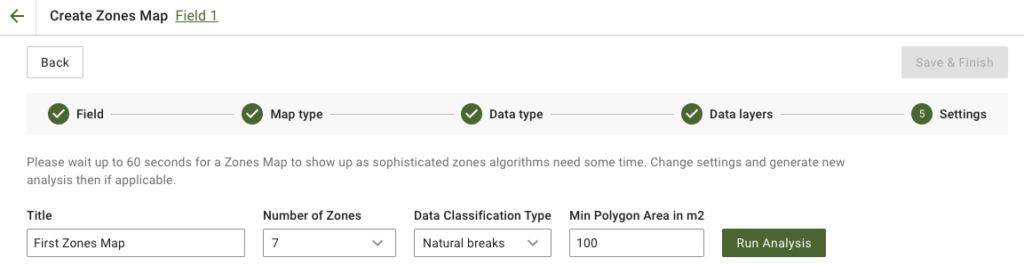
4. Nel passaggio successivo puoi modificare il titolo, cambiare il numero di zone, [selezionare un tipo di classificazione dei dati](https://docs.geopard.tech/geopard-tutorials/it/tour-del-prodotto-app-web/zones-maps-and-analytics/using-data-classification.md) e definire l’area minima del poligono in metri quadrati. Fai clic su **Avvia analisi** per continuare.
L’analisi può richiedere fino a 60 secondi, a seconda dei parametri specificati.
5. Al termine, fai clic su **Salva e termina**.
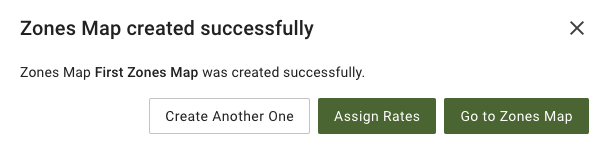
Dopo aver salvato, vedrai il seguente messaggio:
Puoi creare un’altra mappa delle zone, assegnare le dosi oppure aprire la mappa delle zone appena creata. Se la apri, vedrai una schermata simile.
---
# Agent Instructions
This documentation is published with GitBook. GitBook is the documentation platform designed so that both humans and AI agents can read, navigate, and reason over technical content effectively. Learn more at gitbook.com.
## Querying This Documentation
If you need additional information that is not directly available in this page, you can query the documentation by asking a question.
Perform an HTTP GET request on the following URL with the `ask` and `goal` query parameters:
```
GET https://docs.geopard.tech/geopard-tutorials/it/tour-del-prodotto-app-web/zones-maps-and-analytics/create-a-zones-map-using-soil-yield-or-as-applied-data.md?ask=&goal=
```
`ask` is the immediate question: it should be specific, self-contained, and written in natural language.
`goal` is what the user is ultimately trying to achieve, the reason they need the answer. Sharing it helps GitBook give you a better, more relevant answer. A goal is most helpful when it describes the outcome the user wants rather than restating the question. For example, with `ask=how do I create an API token`, a goal like `automate deployments from our CI pipeline` lets GitBook tailor the answer to that use case.
The response will contain a direct answer to the question and relevant excerpts and sources from the documentation.
Use this mechanism when the answer is not explicitly present in the current page, you need clarification or additional context, or you want to retrieve related documentation sections.